

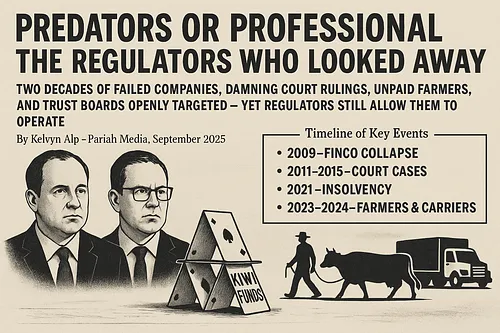
Two decades of failed companies, damning court rulings, unpaid farmers, and trust boards openly targeted — yet regulators still allow them to operate.
The Record of Urquhart and Flett
Craig Urquhart and Alastair Flett continue to present themselves as fund managers. Yet the record shows a consistent pattern: failed companies, unpaid creditors, litigation defeats, and investor losses.
Their investment offerings have been wrapped in assurances of safety, security, and mortgage-backing. Time and again, those assurances have proven unfounded.
Early Warnings
The courts had already identified the risks more than a decade ago:
Spanbild v Urquhart & Miller — the Court ruled there was “no arguable defence” when Urquhart refused to pay his share of a $1.2 million shortfall.
Tubbs v Urquhart — Justice Heath recorded that receivers had to seek an arrest order after Urquhart refused to hand over company records.
The record was already clear: obstruction, non-compliance, and leaving others to carry the financial burden.
Insolvency in 2021 — While Raising Funds
In Re Urquhart [2021] NZHC 1326, Urquhart admitted debts approaching $5 million and proposed to settle at 8.5 cents in the dollar. The Court rejected it, noting “serious public concerns” about his conduct.
At the same time, he and Flett had registered Kiwi Funds Limited and were raising millions from wholesale investors. The contradiction is stark: in court, insolvent; outside court, soliciting investor capital.
The Oxford Finance Case — Pointe Ormiston
The Oxford Finance case underlines the risks. Urquhart borrowed through Pointe Ormiston Estate Limited, but records show he never made a single repayment. His co-director was left financially ruined, losing property as a result.
Companies Office filings were also altered, with documents lodged under the false name “Craig Alexander,” obscuring his history from basic due diligence.
Only Oxford’s threat of public exposure ultimately forced repayment. Regulation did not.
Kiwi Funds: Security That Did Not Exist
By 2024, Kiwi Funds is in the spotlight. Its Information Memorandum stated:
“All investments are secured by first-ranking general security agreements…”
It bore the signature of chairman Alastair Flett, a chartered accountant.
The Court found otherwise: no perfected security existed. In one instance, a GSA was registered only after receivership had begun. Investors who believed they held first-ranking protection were left unsecured. Within five days of the judgment, Flett resigned from all related entities.
Carriers and Farmers Left Exposed
The consequences were not confined to investors on paper.
Between 2023–2024, multiple transport carriers financed by Urquhart and Flett went into receivership or liquidation. When they sought account statements, they were refused.
Farmers who sold livestock through traders financed by them went unpaid — in some cases hundreds of thousands of dollars.
In May 2024, South Island carriers approached this investigation to expose the scale of the problem.
Invoice Factoring and Investor Funds
Further inquiry shows that the carriers and farmers were trading with Urquhart and Flett through their entity NZ Trade Finance Limited, which provided invoice factoring to transport operators and livestock buyers. The funds for this factoring came directly from investor money advanced into Kiwi Funds, the wholesale investment vehicle controlled by both men.
The Kiwi Funds Information Memorandum — recently sourced and supplied to us directly by NZ Invest Group (a new phoenix-branded investment vehicle under which Flett and Urquhart are now trading, seemingly to distance themselves from the Kiwi Funds brand following the October 2024 judgment — though notably, the IM itself still carries Kiwi Funds branding) — states that all such investments are to be secured by first-ranking securities, including general security agreements and mortgages. Kiwi Funds then lent into NZ Trade Finance Limited and NZ Finance Group Limited on those terms. These were the same terms presented to the Māori trust board investor.
However, the October 2024 judgment (sourced from NZLII) found these very terms were not complied with. For over 12 months, Kiwi Funds had knowingly failed to perfect securities, misleading investors about the protection of their money. Pariah media contacted, the investors named in the October 2024 decision, who declined to comment, as citing there is further ongoing High Court proceedings with Kiwi Funds.
This entire investigation began with an aggrieved transport carrier and livestock buyer — FFL Group — (to which NZ Finance Group Limited placed into receivership in March 2024) contacting the platform on the record, alongside multiple South Island carriers who described being on the receiving end of “big bully boy” tactics by Urquhart in particular. Urquhart himself communicated with this platform on multiple occasions, accusing his victims of misinformation. Notably, in the October 2024 judgment, he was found to have misled investors in his dealings.
A clear pattern has emerged throughout this 14-month investigation: victims consistently report being subjected to smear campaigns by both Urquhart and Flett. Their strategy appears consistent — the best form of defence is attack.
During this period, a senior member of an iwi trust was also subjected to a targeted defamation campaign, leaving them to fight for personal and professional survival while litigation continued. The record shows that for Urquhart and Flett, court action is not an exception but a recurring feature of their business model.
Trust Boards Targeted
In October 2024, a trust board was informed that its investments with Urquhart and Flett were “lost.” Instead of restitution, trustees faced aggressive litigation and public criticism.
The timing was notable: these events coincided with the October 2024 judgment against Kiwi Funds. Within days, Flett resigned from all entities.
Fear and Intimidation
Accounts from victims and former employees describe a strategy of fear:
Urquhart is said to boast he can “drag you to hell and back” through litigation.
Flett is reported to deflect scrutiny by attacking the character and record of those who complain.
Meanwhile, lifestyle signals diverge sharply from insolvency claims. In 2021, Urquhart declared himself broke before the High Court; outside it, he continued to live in luxury.
A Familiar Model
The record across cases shows a recurring model:
Investor funds diverted into unrelated acquisitions (Permadeck, Quilt, commercial and residential property).
Investors later told their money was unavailable, tied up and then ultimately “lost.”
At Norfolk Funds Management, both men were forced out for non-disclosures, insolvency issues and ongoing court matters.
Those who challenged them reported being attacked, discredited, or drawn into protracted litigation.
In July and August 2024, Urquhart spoke openly on the record, but later sought to recast or deny those statements.
The Pattern
The record across cases shows the same cycle:
Offer security that does not exist.
Raise capital under the wholesale investor exemption.
Collapse, leaving creditors and investors unpaid.
Deploy litigation against victims, often funded from their own money.
Harass or intimidate complainants.
Withdraw, rebrand, and re-emerge under new structures.
Courts have recognised this. Victims have lived through it. Regulators, however, have not intervened.
Why Reform Is Needed
The wholesale investor exemption remains the central shield. It allows capital to be raised without requiring operators to prove they are fit and proper. Victims face prohibitive legal costs, while the operators continue unchallenged.
Judges have already sounded the alarm:
“No arguable defence.”
“Failure to comply.”
“8.5 cents in the dollar.”
“Serious public concerns.”
The question is no longer about evidence. It is about regulatory will.
Conclusion
The record shows a long trail of collapsed companies, unpaid debts, and investor losses tied to Urquhart and Flett. What also emerges is a pattern of regulatory inaction. Until the wholesale investor exemption is reformed, the cycle of collapse and re-emergence is likely to continue.
Timeline of Key Events
2009 – Finco Collapse: Court describes “no arguable defence.”
2011–2015 – Litigation: Spanbild and Tubbs confirm obstruction and refusal to comply.
2021 – Insolvency: Attempt to walk away from $5m at 8.5c/$1. Court cites “serious public concerns.” Kiwi Funds already registered.
2021–2023 – Oxford Finance: Pointe Ormiston loans collapse. False filings under “Craig Alexander.” Repayment only after exposure threat.
2023–2024 – Farmers & Carriers: Carriers liquidated; farmers unpaid. Operations channeled through NZ Trade Finance Limited, funded by Kiwi Funds.
October 2024 – Kiwi Funds Judgment: Court finds no perfected security. IM signed by Flett. Resignations within five days.
October 2024 – Trust Board: Investments declared “lost.” Trustees targeted with litigation. Urquhart himself communicating with this platform. The investigation itself began with FFL Group and other South Island carriers raising concerns of “bully boy” tactics.
2024–2025 – NZ Invest Group: Emerges as a new phoenix-branded investment vehicle for Flett and Urquhart, even as the IM remains under Kiwi Funds branding.
2025 – Still Operating: Complaints continue. Victims remain exposed.
