

For decades, New Zealanders have been conditioned to choose their government the same way many choose a product off a supermarket shelf: by the packaging. Charisma, stage presence, carefully managed media moments, and the cultivated image of the front man or front woman have repeatedly outweighed rigorous scrutiny of policy substance and the political will required to implement it. Voters ask themselves who looks strong, who sounds reassuring, or who performs best in the latest televised clash. Far fewer ask the harder questions: Who has the best policies? Who has the intestinal fortitude to fight for those policies when the pressure comes? Who is prepared to stand against the entrenched interests that profit from the status quo remaining intact?
The result is predictable. Elections become contests of personality rather than contests of ideas. The two-horse race between National and Labour dominated the political landscape for generations. Even after the introduction of Mixed Member Proportional representation, the system largely evolved into coalitions that function as offshoots or junior partners of the same two dominant forces. Ideological differences between these groupings are often marginal. The rhetoric changes; the underlying approach to power, centralisation, and external influence rarely does. Problems that surface every election cycle – housing unaffordability, declining productivity, erosion of sovereignty, cost-of-living pressures, and the steady transfer of decision-making away from the people – are never resolved. They are managed, deferred, or rebranded. Sticks and carrots are deployed. Promises are made. Delivery is optional.
It’s not accidental. It’s the usual game. Globalist influences, bureaucratic capture, and networks of control thrive when the political class remains interchangeable and the public remains distracted by personalities. Real solutions that threaten the status quo invite immediate and coordinated attack. Few politicians are willing to absorb that cost. Manufactured outrage narratives are deployed with precision, ensuring the gullible fall into line. The ill-informed are guided by emotion, selective information, and social pressure rather than by careful assessment of outcomes. Politicians understand this dynamic and exploit it. Votes are directed rather than freely chosen on the basis of what is right.
Many New Zealanders complain between elections about the same failures. Yet as polling day approaches, the “wasted vote” narrative returns with reliable force. Coordinated attacks intensify against any party that offers a genuine alternative. Armchair critics, who have never had to build a coherent policy platform or withstand the institutional pressure that accompanies challenging power, declare that supporting New Zealand Loyal is pointless because “no one else will vote that way.” This is self-sabotage dressed up as realism. It’s the same logic that keeps the cycle intact.
History offers a recent reminder. Prior to the last election, NZ First was not even in Parliament. The people had removed them. A carefully crafted strategy then repositioned the party to capture those disillusioned with the previous government, including segments of the freedom movement. Once again, many fell for the con. People speak of wanting justice for the harms inflicted by the state in recent years, yet they repeatedly return the same political class – or its close variants – to positions where they can commit further harms and provide cover for those responsible. You think that’s pragmatism? No, it’s lunacy.
Some parties now promote Direct Democracy as the answer. On the surface it appeals. In practice, a poorly informed population voting on complex matters without structural safeguards is as dangerous as any dictatorship. Without serious constitutional reform – including a real, written constitution that places clear limits on power and protects fundamental rights even when temporary majorities demand the opposite – popular votes can simply accelerate damage. The protection of the informed and the uninformed alike requires institutional guardrails, not the hope that the next referendum will magically produce wisdom.
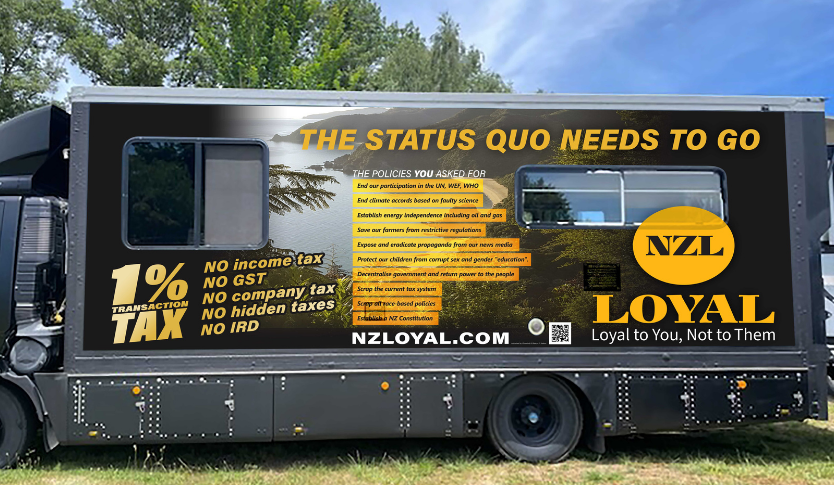
New Zealand Loyal exists precisely because the old game no longer serves the country. It rejects the mild, interchangeable politics of the major blocs and their satellites. It puts forward tangible solutions aimed at the recurring problems that other parties treat as permanent features of the landscape. Those solutions threaten vested interests. That is why the attacks come thick and fast. That is also why the party is necessary.
This election remains in your hands. Do not allow shills, trolls, or those posing as pragmatists to convince you that your vote only counts if it is cast for the options they prefer. The only wasted vote is the one given to something you do not believe in, or the one that guarantees more of the same. Be equally wary of those who claim to share your concerns while quietly steering you back into the same captivity under a different brand.
Policy over personality. Substance over spectacle. Courage over convenience. The alternative future is available. Whether it’s chosen is a decision for the people of New Zealand – not for the narrative managers who benefit from keeping the choice narrow.

Beautifully put Kelvyn! The pre-election circus is in full swing – surely more and more New Zealanders will start becoming aware of the farce that it is, and begin to apply some common sense, and vote for improvements, not more of the same? … we can live in hope – our country depends on it!